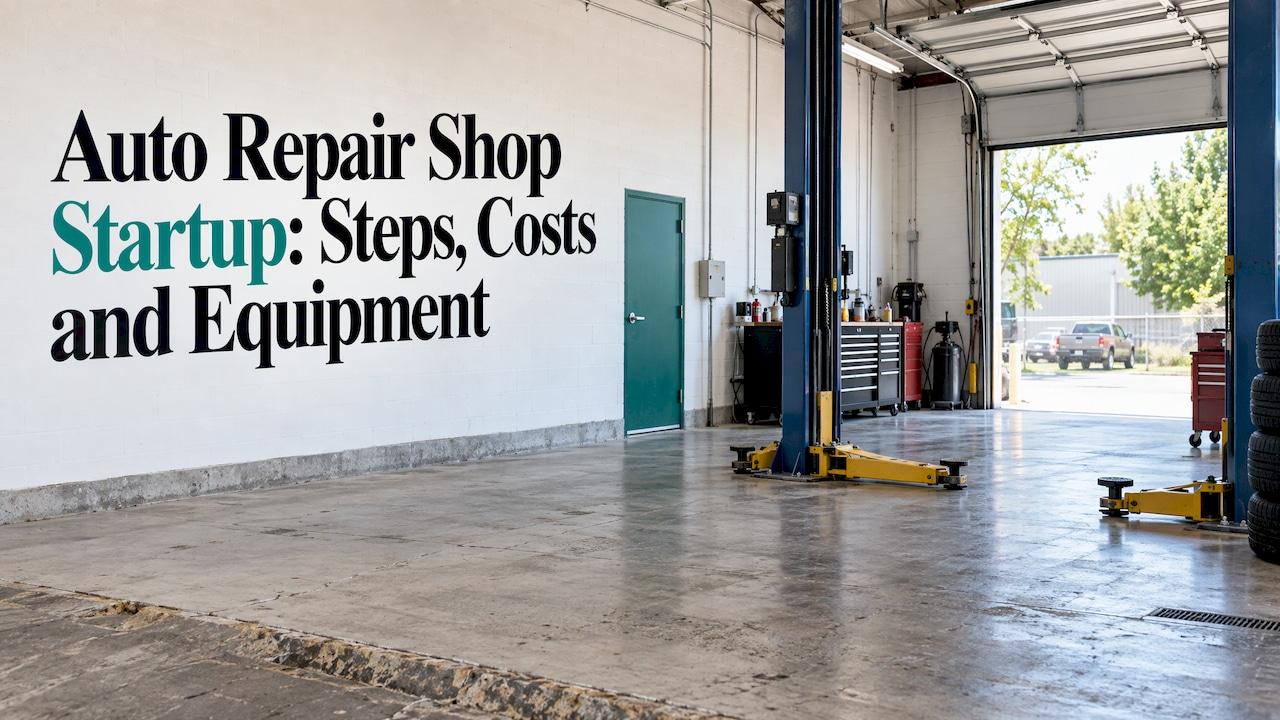
Starting an auto repair shop comes down to five decisions made in the right order: the services you will sell, a premises where that work is legally allowed, the money to carry you through the first months, the insurance and permits that go with it, and the equipment that lets you bill hours from week one. Published estimates put a US independent shop at roughly $50,000 to $250,000 to open, and the equipment is the largest part you control. We supply lifts, wheel service equipment and shop equipment with free shipping, a price-match guarantee and a 12-month warranty, so this guide puts the equipment decision in its place in the whole plan.
TL;DR
- Define your service menu first. It decides your licenses, insurance, equipment and floor space.
- Confirm in writing that repair work is allowed at the address before you sign a lease.
- A US independent shop is commonly estimated at $50,000 to $250,000 to open, including three to six months of working capital.
- A two-bay general-repair shop is estimated at $40,000 to $60,000 for new equipment: lift, scanner, compressor and tools come first, alignment later.
- Quote, authorize and track every job in writing from day one.
Table of Contents
- Choose your shop model and service menu first
- Write a lean plan with real numbers
- What it costs to open an auto repair shop
- Premises, zoning and permits
- Insurance and documentation
- Equipment: what to buy first, and in what order
- Set prices that cover your real costs
- Hire, open and keep records
- Our view: buy the equipment once
- Equip your new shop with us
- FAQ
- Sources
Choose your shop model and service menu first
Before you look at a single building, decide what kind of shop you are opening. The usual choices are an independent general-repair shop (oil changes, tire rotations, brakes, engine repair), a specialty shop focused on one brand or a narrow set of services, or a mobile operation. ERGO NEXT's guide to starting a mechanic shop notes that a garage costs more but gives you weather protection and room to store parts, while mobile work cuts overhead but limits inventory and depends on the weather.
The service menu is not a marketing detail. It sets which permits you need (refrigerant handling for air conditioning, for example), which equipment you buy and how much space you lease. A California opening checklist from Aftermarket Matters tells new owners to define their services and a unique selling proposition, identify competitors and target customers, and decide between general repair and a manufacturer-specific focus before they commit to anything else.
A practical test: write down the ten jobs you expect to do most in the first year. If eight of them need a lift, you are a lift shop, and your floor plan and budget should say so.
Write a lean plan with real numbers
You do not need a forty-page document. You need a plan that tells you what the shop costs to open, what you must charge, and how long your cash lasts. A useful plan covers the business overview and structure, the local market, your services and pricing, financial projections and how you will find customers, as the ERGO NEXT guide lays out. The Wrench & Wallet opening workbook adds practical advice: talk to at least three shop owners, check your personal credit, decide whether to start from scratch, buy or franchise, and plan six to twelve months ahead.
The two figures that sink new shops are the ones owners skip: the monthly overhead you must cover before the first dollar of profit, and the working capital that pays for the slow first months. Put both in the plan as numbers, not intentions.
What it costs to open an auto repair shop
Autoleap's August 2026 cost guide estimates $50,000 to $250,000 for a US independent shop. That total covers premises, equipment, improvements, business formation, insurance, marketing and three to six months of working capital. The same guide puts first-year insurance at $4,000 to $12,000 and working capital at $15,000 to $60,000. These are blog estimates and vary with your city, building and service menu, so treat them as a range to test against local quotes.
How the money breaks down for a two-bay general-repair shop:
| Cost area | Published estimate (US) |
|---|---|
| Total startup, independent shop | $50,000 to $250,000 |
| New equipment, two-bay general repair | $40,000 to $60,000 |
| First-year insurance | $4,000 to $12,000 |
| Working capital | $15,000 to $60,000 |
Equipment is the line where your choices matter most. Rent and insurance are largely set by the market. Equipment is set by the services you decide to sell and the order in which you buy.
Funding the opening
Most new owners combine savings with a loan. The U.S. Small Business Administration's 7(a) loan guarantee program is designed to help entrepreneurs start or expand small businesses through bank and non-bank lenders. Lenders will ask for your plan, your startup cost breakdown and a quote for the equipment, so get itemized equipment quotes early. When you request a quote from us, you can list the lift, wheel service and shop equipment you need in one request and keep the paperwork together for your lender.
Premises, zoning and permits
The order matters here: confirm zoning, then lease. The Wrench & Wallet workbook advises getting written confirmation from the town that auto repair is allowed at the address, having a lawyer review the lease (especially triple-net terms and personal guarantees), and ordering a Phase I environmental assessment for a former garage. It also suggests looking at former repair shops, which may already have suitable electrical service and lift locations.
Permits differ by state and city, so use your own state and local agencies as the final word. To show how varied the list can be, the Arizona Department of Environmental Quality lists possible permits for an auto repair shop, covering hazardous-waste identification, used oil, battery recycling, underground tanks, waste-tire storage, vehicle washing and discharges. In general, expect a business license, an occupancy permit, an EIN where applicable and environmental credentials. If you service vehicle air conditioning, the technician needs EPA refrigerant-handling certification. ASE certification is generally optional but helps with credibility, according to the ERGO NEXT guide.
Set up waste pickup for used oil, filters, batteries and tires before you open, not after the first overflowing drum.
Insurance and documentation
You are holding other people's vehicles, so insurance is a requirement of the business model, not an extra. Ask an agent who writes garage coverage about the policies that apply to your state and services. Then build your paperwork around the claim you hope never to have: written estimates, signed repair authorizations, and records of parts and labor on every job.
That documentation also helps customers whose repairs go through an insurer. If you refer collision work, look at how a full-service body shop handles insurance claim repair documentation: itemized estimates and records that an adjuster can follow. Your mechanical shop benefits from the same habit.
Equipment: what to buy first, and in what order

A new shop does not need every machine on day one. It needs the equipment that lets your most common jobs move through a bay quickly and safely. The Autoleap guide lists a two-post lift, scanner, air compressor, technician tool set and an optional alignment rack, and recommends prioritizing equipment for your service menu and delaying alignment until revenue is steady.
Published 2026 US price ranges for the core items:
| Item | Estimated range |
|---|---|
| Two-post lift | $3,700 to $7,000 |
| OBD-II scanner | $2,500 to $8,000 |
| Air compressor | $1,200 to $3,000 |
| Full technician tool set | $10,000 to $20,000 |
| Alignment rack | $15,000 to $35,000 |
Add the first four and a minimum setup lands between about $17,400 and $38,000 before a second bay, storage, lighting and safety gear. Those are Autoleap's ranges, not our prices, so use them to size your budget, then request quotes for the exact models you want.
Lifts: the machine that sets your capacity
The lift decides how many cars you can work on and how quickly. A two-post lift is the general-repair standard. If you are tight on space or starting with a single bay, our portable and scissor lifts and models such as the 6000TLX portable car lift and the 8000TL portable car lift fit smaller footprints. If you work on heavier vehicles or want storage and service in one position, browse four-post lifts. For a shop planning alignment work, alignment lifts and alignment combo kits keep the lift and the rack as a matched set, and lift combo packages bundle equipment for owners who want one order instead of several.

Before you order any fixed equipment, verify the floor space, ceiling height, power supply and lifting capacity. An Oman workshop guide makes a point worth copying anywhere: ask for quotes that separate purchase price, delivery, installation, training and after-sales support, so you compare like with like.
Tire and wheel service
Tires are steady revenue for most general shops. If your menu includes tire mounting, rotation and balancing, plan for a tire changer, a balancer and wheel handling. Our wheel service range includes wheel balancers and wheel lifts, and floor jacks and other shop equipment round out the bay.
Storage and organization
Technician tool sets are one of the biggest equipment lines, so protect them. Good tool storage keeps tools findable, which means fewer minutes lost per job and fewer replacements.
Safety is part of the equipment decision
Lifts are the first place new owners should look at safety. OSHA's Regional Emphasis Program for Automotive Services lists the hazards it targets in this industry: crushing from improper use or maintenance of lifts and floor jacks, noise, tire explosions, machine-guarding hazards, uncovered pits and chemical exposure. Have fixed equipment installed to the manufacturer's instructions, inspect it on a schedule, train every technician on it, and keep PPE and fire protection within reach.
Set prices that cover your real costs
Copying the shop down the street is the quickest way to underprice. Survey local labor rates for reference, then build your own. Mujgoš's pricing guide recommends calculating fully loaded overhead, dividing it by realistically billable hours, adding loaded technician cost and a target gross margin, and using itemized written estimates with approval before any work starts.
A worked example with simple numbers: if your fixed monthly costs are $12,000 and two technicians can realistically bill 240 hours a month between them, overhead alone is $50 per billable hour before wages, parts margin or profit. That is why billable hours matter more than open hours, and why a lift that keeps a bay turning over pays back faster than one that sits idle.
Hire, open and keep records
A technician is the priority hire. Depending on your services you may also want a service writer or receptionist, and a body shop will need collision specialists, according to Nav's guide to financing an auto repair business. Once you open, track every billed hour and dollar from day one, ask satisfied customers for reviews, set up a business profile and signage, and write down the process from drop-off to pickup so it works when you are under a car.
Our view: buy the equipment once
Most new shop budgets break at the same point: the owner buys a bargain machine to save cash, then loses bay time, or pays for a second purchase later. We think a new shop should treat the lift and wheel service equipment as the working core of the business and buy it for the service menu it actually plans to run.
That is why we pair a 12-month warranty on our products with free shipping and a price-match guarantee. When your launch budget is fixed, you should not have to choose between a fair price and equipment from top brands, and a warranty means a faulty unit is something you can raise with us rather than absorb.
Start with the lift and the tools that earn in the first month. Add alignment when your revenue supports it. Our customer service team is there to help you match the equipment to your bays, your power supply and your work.
the author
Equip your new shop with us
We supply car lifts, wheel service equipment, garage storage and shop equipment for professional mechanics, DIY users and new shop owners. Every product comes with a 12-month warranty, free shipping and our price-match guarantee, and our customer service team can help you choose.

Start with our car lifts or browse the full range at Garage Equipments.
FAQ
How much money do I need to start an auto repair shop?
Published estimates for a US independent shop run from about $50,000 to $250,000, depending on location, building and services. That includes equipment, insurance, formation costs, marketing and three to six months of working capital, per Autoleap's 2026 guide. Get local quotes to narrow the range for your market.
Do I need a license to open a repair shop?
Expect a business license, an occupancy permit and environmental compliance such as used-oil and hazardous-waste handling, and EPA refrigerant certification for anyone servicing vehicle air conditioning. Requirements vary by state and city, so confirm with your state environmental agency and local zoning office. The ERGO NEXT guide gives a general overview.
What equipment does a new two-bay shop need first?
A two-post lift, an OBD-II scanner, an air compressor and a full technician tool set. Add tire and wheel equipment if tires are on your menu, and delay alignment until revenue is steady. Our lift combo packages are one way to buy several pieces together.
Should I start with a garage or go mobile?
A garage costs more but gives you weather protection and space for parts and lifts. Mobile work lowers overhead but limits inventory and depends on the weather. If your menu needs a lift, plan for a fixed shop.
Sources
- How to Start a Mechanic Shop, ERGO NEXT Insurance
- Checklist: Basic steps for opening an auto repair business in California, Aftermarket Matters
- How Much Does It Cost to Open a Mechanic Shop?, Autoleap
- Auto Repair Shop Opening Workbook, Wrench & Wallet
- SBA Loans Give Entrepreneurs a Hand Up, SBA Office of Advocacy
- Permit(s) needed for an Auto Repair Shop, Arizona DEQ
- Regional Emphasis Program for Automotive Services, OSHA
- Opening an Auto Repair Shop in Oman, Connsect
- Setting best prices and billing for auto repair shop, Mujgoš
- How To Start and Finance Your Own Auto Repair Business, Nav
- Collision Repair in Fords NJ, Leslie's Auto Body