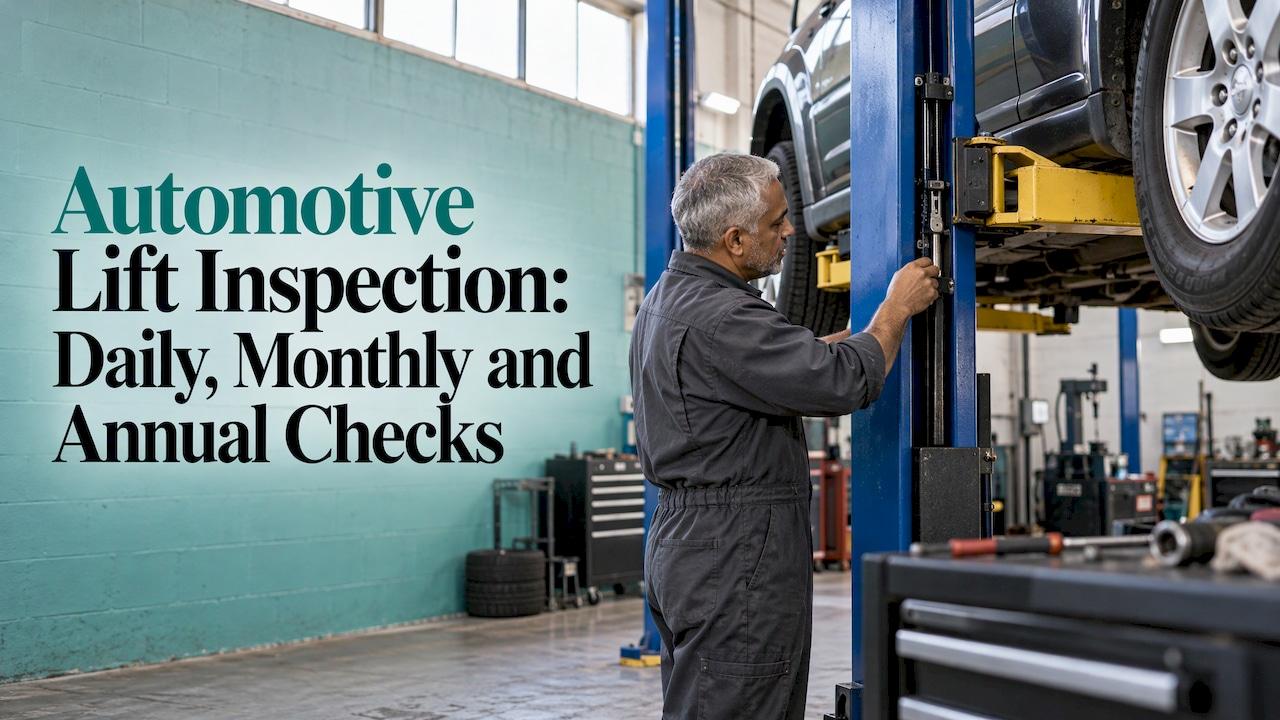
An automotive lift inspection in the US is a three-layer routine: the operator checks the lift before every use, the shop does a deeper structural check monthly, and a qualified lift inspector certifies it at least once a year under the national lift standard. Federal OSHA has no rule written specifically for lifts, but the standard is how inspectors, insurers and local authorities judge your shop. Start with a lift that comes with a manual, labels and a 12-month warranty, such as the car lifts we supply, and the routine below is easy to keep.
TL;DR
- Inspect before every use, check structure and anchors monthly, and have a qualified inspector certify the lift at least annually.
- The governing US standard is ANSI/ALI ALOIM:2020. Certification is voluntary unless your local authority makes it compulsory.
- Test the mechanical safety locks every time you raise a vehicle. If anything fails, stop using the lift and tag it out.
- Keep written records: inspector findings, repairs, parts replaced and operator training.
Table of Contents
- What the rules actually require in the US
- Why the annual inspection is worth having
- The three-layer inspection routine
- Daily pre-use checks
- Monthly checks
- What a qualified inspector does
- Testing safety locks
- Records to keep
- A worked example: a two-bay shop
- Our perspective
- Choosing a lift that is easy to inspect and keep compliant
- FAQ
- Sources
What the rules actually require in the US
The Automotive Lift Institute (ALI) explains that OSHA has no regulations directly addressing vehicle lifts. A 1996 federal law, the National Technology Transfer and Advancement Act, lets OSHA apply nationally recognized standards such as ANSI/ALI ALOIM to meet its safety mission. In practice, OSHA's own page on standards applicable to service lifts is not the end of the story: the consensus standard is what gets cited.
That standard, ANSI/ALI ALOIM:2020, covers use, inspection and maintenance. It requires periodic inspection by a qualified lift inspector at least annually, trained operators, defined owner and employer responsibilities, and replacement parts that are OEM-approved or match original specifications.
Whether certification is mandatory depends on where you are. ALI says that in North America it is voluntary unless an Authority Having Jurisdiction (AHJ, the local building or safety office) makes it compulsory, and a growing number of AHJs do. California is one example: Title 8, Section 3542 requires that operation, inspection and maintenance be performed by a qualified person following manufacturer-recommended procedures, with ALI standards as guidelines.
The practical rule: follow the manufacturer's manual, meet ALOIM, and ask your local authority what it enforces.

Why the annual inspection is worth having
ALI notes that health and safety officials regularly check for proof of annual inspections and operator training during site visits, and that annual inspections help protect against violations and fines. Beyond paperwork, the lift is the one machine in your shop that holds a two-ton vehicle over your head. Cables fatigue, anchors loosen and hydraulic seals weep slowly enough that nobody notices from day to day.
The three-layer inspection routine
| Frequency | Who | Focus |
|---|---|---|
| Before each use | Operator | Labels, controls, locks, leaks, contact points |
| Monthly | Shop technician or lead | Anchors, columns, cables, chains, fasteners, oil level |
| Annually (at least) | Qualified lift inspector | Full structural, mechanical, hydraulic, air and electrical review |
Some rule sets run tighter. SafeWork SA in Australia requires daily checks, inspections at least every three months and an annual independent inspection, and UK guidance from the Garage Equipment Association recommends six-monthly thorough examinations. If you operate outside the US, follow your own country's rules. The table above is the US baseline.
Daily pre-use checks
The operator does these before the first vehicle of the day. Following ALI's daily-check guidance, verify that:
- Operating instructions, warning labels and capacity markings are present and readable.
- Controls, synchronizing systems, restraints and locking devices work properly.
- Components and vehicle-contact points show no excessive wear.
- There are no hydraulic or pneumatic leaks, unusual noises or erratic movement.
- The floor around the anchors is not cracked or loose.
The Canadian safety agency CCOHS adds useful operating habits. Know the rated load on the nameplate, keep people about 6 ft away before lifting, and check structural parts, hoses, wires and drive chains. Before raising a vehicle, it advises putting the transmission in neutral, turning the ignition off and closing the doors. Check for overhead obstructions and engage the latches. Raise the vehicle until the wheels clear the floor by about a foot, re-check the contact pads, then lock the lift.
Monthly checks
Monthly work goes deeper into the parts that wear out of sight. A typical monthly checklist covers:
- Oil level and leaks, valves and hoses
- Cables, chains, pulleys, pins and sprockets
- Columns, posts, the rolling bridge and rollers
- Anchors and fasteners
- Swing-arm restraints, runway stops and ramps
- Lift locks, limit switches and electrical terminals
Record comments and the date each item was repaired or replaced, and write "NI" for anything not inspected. Treat any sample checklist as a template: your manufacturer's manual sets the required items and frequency for your model.
What a qualified inspector does
ALI says a proper inspection examines structural, mechanical, hydraulic, air and electrical systems, using the manufacturer's inspection points and ALOIM. Depending on lift type, that can be up to 120 points. The inspector also reviews labels and documentation: operating instructions, vehicle-lifting information, safety materials and training logs.
When the inspection is done you should receive a written record of the findings for every inspection point, plus any adjustments made or parts replaced. Keep all inspection certificates on file. ALI also recommends an inspection by a certified inspector whenever a lift is newly installed, to confirm documentation, markings, operator training and installation meet ALOIM.
If you are buying equipment for a new bay, plan the inspection date at the same time as the delivery date. Our two-post, four-post and scissor lifts all ship free, and the 12-month warranty gives you a clear baseline for the first year of records.
Testing safety locks
Mechanical locks are what keep a vehicle up if hydraulic pressure is lost, so they get tested every lift, not just on inspection day.
- Raise the vehicle a foot or so and confirm the locks audibly engage on every column or arm.
- Lower the lift gently onto the locks and confirm it rests on them, not on hydraulic pressure.
- Look for worn, bent or sticky lock parts, and for lock release cables that are frayed or slack.
- Confirm arm restraints and stops engage, and the contact pads sit on the manufacturer's lift points.
If an issue turns up, ALI's guidance is to stop using the lift, report it to the supervisor and lock or tag it out of service until it is resolved. Only qualified service personnel should repair it.
Records to keep
Keep four things together near the lift or in the shop office:
- Inspector certificates and written findings
- Monthly checklists with repair dates
- Operator training logs
- The manufacturer's manual and a log of parts replaced
ALOIM includes appendices for operator training, planned maintenance and repair service logs, which makes a ready-made format.
A worked example: a two-bay shop

Say a shop runs a two-post and a scissor lift. Each morning the first technician walks both through the five daily checks, about five minutes each. On the first Monday of the month the lead technician runs the monthly list and notes a weeping hose fitting on the scissor lift. The lift is tagged out, the fitting replaced and the date recorded. In the spring a certified inspector visits, reviews the logs and issues a certificate for both lifts. When an inspector or insurer asks, the shop has a year of paper. That is the whole system.
Our perspective
Most lift trouble we hear about comes down to equipment that was never set up to be inspected: missing manuals, unreadable labels, no record of what was replaced. We think the best inspection program starts at purchase. That is why we supply lifts from top brands, with a 12-month warranty, free shipping and a price-match guarantee, so a shop owner can spend the budget on the bay and not on surprises.
A lift that arrives with its documentation, and an owner who logs the first daily check, builds a clean record from day one. Whether you are a professional shop or a home garage with a portable lift, the routine is the same, and it protects you and whoever is under the vehicle.
the author
Choosing a lift that is easy to inspect and keep compliant
When you shop for a lift, think about how it will be inspected for years. Look for clear capacity labelling, accessible locks and anchors, and complete manuals. Browse our car lifts by type, including portable lifts for smaller bays, or see the full range on our site. Every product carries our 12-month warranty and free shipping.

FAQ
How often should an automotive lift be inspected?
Operators should check it before every use, and a technician should do a structural check monthly. A qualified lift inspector should inspect it at least annually under ANSI/ALI ALOIM:2020. Your manufacturer's manual may require more.
Is a lift inspection legally required?
OSHA has no lift-specific rule, but it can apply recognized standards like ALOIM. Certification is voluntary unless your local authority requires it. Some states, such as California, set requirements for qualified-person inspection, so check with your local authority.
What should I do if a safety lock fails?
Stop using the lift right away, report it to your supervisor and lock or tag it out of service. Have qualified service personnel repair it before anyone uses it again.
What should be on a lift inspection checklist?
Cover labels and capacity markings, controls, locks, hydraulic and air leaks, cables and chains, contact pads and arms, anchors and floor condition, and electrical components. Use your manufacturer's manual to set the final list.
Sources
- ALI: Annual Lift Inspections
- ALI: Lift Inspection FAQ
- ALI: ANSI/ALI ALOIM:2020
- ALI: Code Enforcement
- ALI daily-check guidance, Fixed Ops Magazine 2016
- California Code of Regulations, Title 8, Section 3542
- CCOHS: Hydraulic Lifts Operation
- SafeWork SA: Vehicle hoists
- GEA: The Safe Operation of Vehicle Lifts
- Monthly Auto Lift Inspection Checklist