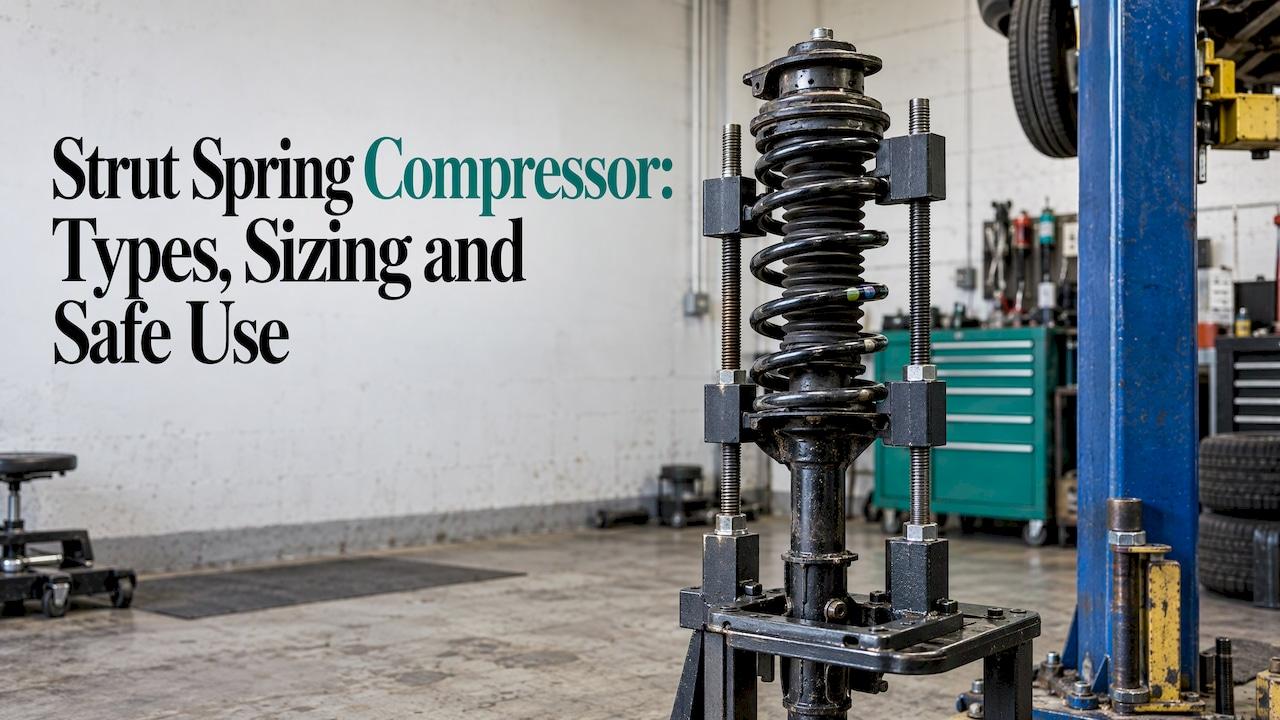
A strut spring compressor clamps onto a coil spring and winds it down so the load comes off the strut mount. That lets you take the strut apart, swap the shock or spring, and load the spring back in safely. Pick the type that fits your strut and spring, use it evenly, and never loosen the top nut until the spring is fully captured. The rest of this guide covers the types, how to size one, the step-by-step method, and the creeper that keeps the job comfortable.
TL;DR
- A compressor holds the coil spring under tension so the strut can be disassembled, then loads the new spring on reassembly.
- External compressors grip the outside of the spring. Internal ones sit inside the coil. Bench presses suit volume work.
- Match the hook or jaw range to your spring diameter, and choose a tool with a rated capacity above the spring's load.
- Compress evenly, in small alternating turns, with hooks on several coils. Do not touch the top nut until the spring is confirmed free of tension.
- A creeper that suits your floor makes the whole job easier on your back.
Table of Contents
- What a strut spring compressor actually does
- Types of strut spring compressors
- How to choose the right one for your vehicle and job
- How to use a strut spring compressor safely
- Setting up the bay for suspension work
- Choosing a creeper for under-car work
- Our perspective on equipment for suspension work
- Equip your bay with Garage Equipments
- FAQ
- Sources
What a strut spring compressor actually does
A coil spring on a strut is under constant load. The Drive notes that these springs are tight enough to bear the weight of an entire car. On a MacPherson-style assembly, the spring sits between a lower seat on the strut body and an upper seat under the strut mount. The center nut on the strut rod is the only thing holding all that energy in place.
That is the reason you cannot simply undo the nut. A compressor shortens the spring, which unloads the upper seat. Once the spring is held by the tool instead of the nut, you can remove the nut, lift off the mount and bearing, and slide the spring and strut apart. For a replacement, the tool does the same job in reverse: it squeezes the new spring enough to fit the strut and seat it correctly.
The same logic applies to a few other jobs, such as swapping a spring on a coilover or replacing a shock with a separate spring. If a spring is held under load, you need a purpose-built tool to control it.

Types of strut spring compressors
There are several designs, and each suits a different situation.
External compressors
These use two C-hook style jaws that grip the spring from the outside, joined by a long threaded rod. According to one suspension tool guide, they are the choice when something blocks the center of the coil. Turn the rod, and the hooks draw together. They are a common sight on MacPherson struts and are the style most home mechanics picture.
Key points when using external compressors:
- Use a pair so the load is shared across two sides, hooked onto opposite sides of the spring.
- Seat each hook on several coils rather than one, so the load is spread.
- Keep the rods parallel and turn each in small steps, alternating between them.
Internal compressors
These slide inside the coil and use a jack-screw with two threaded arms that pull toward each other. Shops often use them on everyday MacPherson struts because the load runs through the center of the spring, which keeps the spring and tool more stable. They need an open center, so check that the strut and spring design leaves room for the tool.
Clamshell and enclosed styles
Clamshell designs wrap around the spring and enclose it, which many mechanics prefer because the spring cannot easily slip out sideways. They cost more than basic hook styles. Some retailers list them at well over a hundred dollars, so factor that in against how often you will use one.
Heavy-duty and bench-mounted tools
Some OEM springs, such as certain high-tension European applications, call for plate-style compressors with a telescoping jack shaft. For volume work, bench-mounted hydraulic or pneumatic presses are faster. They mount to a wall or stand and are built for professional shops that do spring jobs every week. If you run a shop and handle struts regularly, this is the category to think about.
How to choose the right one for your vehicle and job
The best tool is the one that fits your spring, has margin on its rating and is built to take the load. Work through these questions in order.
1. Spring diameter and length
Hooks and jaws have a working range. For example, Hot Rod describes a compressor whose hooks handle spring diameters from 3.5 inches to 11.5 inches. Measure the outside diameter of your spring, and check that the hooks reach around it. Also check the free length of the spring against the travel of the tool's rod. If the rod is too short, you cannot compress the spring far enough to free the nut.
2. Rated capacity
The same article describes a tool rated to compress 3,000 pounds. Rating matters because a tool at its limit is a tool at risk. Choose one with comfortable headroom above what your spring requires, and use the manufacturer's rating as a ceiling, not a target.
3. Build quality
Look for forged or heat-treated steel hooks, a thick threaded rod with clean threads, and a coating that resists corrosion. Check that the hook tips are shaped to seat on the spring wire instead of skating off it. A flimsy tool can fail under load, which is the exact hazard you are trying to avoid.
4. Access around the strut
External hooks need room outside the spring. Internal designs need an open center. Some vehicles with shrouded or tightly packaged struts make one type easier than another, so think about the car in front of you before you buy.
5. How often you will use it
A weekend DIYer replacing one pair of struts has different needs from a shop doing several a week. Occasional users do well with a quality external or clamshell set. Shops tend to benefit from a bench press, which speeds up the work and holds the strut at a comfortable height.
Quick comparison
| Type | Best for | Main consideration |
|---|---|---|
| External hook style | MacPherson struts, general DIY and shop use | Needs hooks seated on several coils and even turns |
| Internal | Struts with open spring centers | Needs room inside the coil |
| Clamshell | Users who want the spring enclosed | Higher price |
| Plate or telescoping | High-tension OEM springs | Specialist use |
| Bench hydraulic or pneumatic | Volume shop work | Needs space and a mounting point |
How to use a strut spring compressor safely
This is one of the riskier jobs in a home garage. OSHA's stored energy toolbox talk explains that a compressed spring releases its energy as fast movement when it expands, and that the release can crush or strike a person. The Drive puts it bluntly: if the spring escapes, you have a metal missile in the garage. Technique is what keeps it controlled.
Step by step
- Raise and secure the vehicle. Lift it on a proper lift or on a jack with stands on solid, level ground. Never rely on a jack alone. Remove the wheel.
- Remove the strut assembly following the service manual for your vehicle, then secure it in a vise or on a bench stand if the design allows.
- Inspect the tool. Check the threads, the hooks and the rod for cracks, bends or wear. Retire any damaged tool.
- Attach the hooks. Carvira's guide advises attaching hooks to at least four or five coils on each side, so the load is spread across enough wire. Place them opposite each other.
- Compress evenly. Turn each arm a little at a time and alternate. The goal is a straight, even squeeze. The Drive warns that uneven compression can cause the tool to slip.
- Confirm the spring is free. The upper seat should lift away from the mount with no pressure. Only when the spring is fully compressed and clearly free of tension should you loosen the top nut.
- Disassemble, swap parts, and reassemble. Seat the new spring correctly in the lower seat, with the end of the coil sitting in its proper pocket, before you let the tool back off.
- Release slowly. Back off the tool in the same alternating small increments, watching the spring seat as it extends.
- Torque the top nut to the vehicle manufacturer's specification.
Mistakes that cause trouble
- Hooking too few coils. A hook on one coil concentrates the load and is more likely to slip.
- Winding one side more than the other. The tool tilts, the hooks walk, and the spring can kick out.
- Loosening the nut too early. Confirm there is no load first.
- Standing in the line of fire. Keep your face and body out of the spring's path while you work.
- Overextending the tool. If the rod is near the end of its travel and the spring is still loaded, stop and use a longer or higher-capacity tool.
- Using damaged or makeshift tools. If the tool shows wear, replace it.
If you feel unsure about any of this, a professional alignment or suspension shop can do the job. Many people also choose a pre-assembled strut, which comes with the spring already installed and removes the compression step entirely.
Setting up the bay for suspension work
A good compressor is only part of a safe setup. You also need the car raised securely and a stable place to work. A lift gives you a comfortable working height and access to both sides of the strut. If you work on your own vehicles, a quality floor jack paired with stands is the core of a safe home setup. Our floor jacks are one place to start. For shops, scissor lifts and alignment lifts are practical choices, because strut replacement is usually followed by a wheel alignment.
After replacing struts, alignment settings change, so plan for an alignment check. Keeping tools organized also saves time, since a strut job involves a lot of sockets, hooks and fasteners. Tool storage keeps them in reach.
Choosing a creeper for under-car work
Many readers searching for a strut compressor also look for the best automotive creeper, since suspension work means a lot of time on your back. A few features decide whether a creeper is a help or a nuisance.
Start with your floor. Car and Driver's tested guide says the number one consideration is the surface you work on. Smooth floors suit low creepers that give you maximum clearance. Bumpy floors, with hoses or textured coverings, call for larger wheels that roll over obstacles without getting hung up. The testers rolled each creeper over textured vinyl, loose nuts and bolts, and an air hose, and rated comfort on a 0.0 to 3.0 scale.
Check the capacity. In one comparison of 14 products, claimed capacities ranged from 250 to 450 pounds. Choose one comfortably above your body weight.
Pick the shape. Industry Today describes three main types: traditional flat boards on casters, contoured designs that follow the body, and folding models that convert to a seat. Folding creepers earn their keep if you want one tool for both under-car work and sitting at the wheel of a job.
Look at the wheels. The same source notes that steel casters give a rough ride and catch in cracks, while ball-bearing wheels are more reliable and comfortable. Wheel sizes in the comparison ranged from 2-inch to 5-inch all-terrain casters.

Mind the cushion. Padding thickness and head support matter on long jobs. If you do strut work, you are likely to be under the car for a while.
Our perspective on equipment for suspension work
At Garage Equipments, we see the same pattern with suspension jobs. The tool in the headline gets the attention, but the setup around it decides how safe and smooth the work goes. A car held securely at a comfortable height, a solid floor jack and stands, organized tools and enough light make a compressor easier to use correctly.
That is why we focus on dependable garage machinery from top brands for both professionals and DIY users. Our lifts, wheel service equipment, floor jacks and storage are chosen with durability in mind, and every product comes with a 12-month warranty. We offer free shipping and a price-match guarantee, and we pride ourselves on attentive customer service, so you have someone to ask when you are deciding what fits your bay.
For a shop owner, the right lift and wheel service gear turns a strut job from a struggle into a routine repair. For a home mechanic, a good jack and a tidy workspace do the same.
the author
Equip your bay with Garage Equipments
If you are planning suspension work, we can help you build a setup around it. Browse our car lifts for a safe working height, our wheel service equipment for the tire and alignment side of the job, and our floor jacks for the garage floor. Every product carries a 12-month warranty, ships free and is covered by our price-match guarantee.

Start at Garage Equipments and pick the category that matches your bay.
FAQ
What does a strut spring compressor do?
It clamps onto a coil spring and shortens it so the tension comes off the strut mount. That lets you remove the top nut and take the strut apart safely. It also compresses the new spring so you can fit it during reassembly.
Should I use an internal or external compressor?
External compressors grip the outside of the spring and suit most MacPherson struts. Internal compressors sit inside the coil and need an open center. Choose by access around your strut, spring diameter and how often you will do the job.
How do I know the spring is safe to unbolt?
The spring should be compressed evenly, with hooks on at least four or five coils per side. The upper seat should lift free of the mount with no load on the top nut. Only then loosen the nut, and keep your body out of the spring's path.
What should I look for in a creeper?
Match it to your floor first. Smooth concrete suits low creepers, while rough or cluttered floors need larger wheels. Then check the capacity, cushioning and whether you prefer a flat, contoured or folding design.
Is a lift necessary for strut work?
Not strictly, since many people use a floor jack and stands. A lift gives a more comfortable height and better access, which helps in a shop or a busy home garage. Whatever you use, never work under a vehicle supported only by a jack.
Sources
- OSHA: Tool box talk for LOTO and stored energy
- The Drive: How To Use a Spring Compressor
- Hot Rod: How to Use a Strut Spring Compressor
- Car and Driver: Best Mechanic's Creepers, Tested
- Which Brand Wins: Mechanic's creeper test
- Industry Today: Things You Need to Know About Mechanics Creepers
- Coil Spring Compressor Tool: Types, Sizes, Buying Guide
- Carvira: How to Replace Strut Mount Bearings