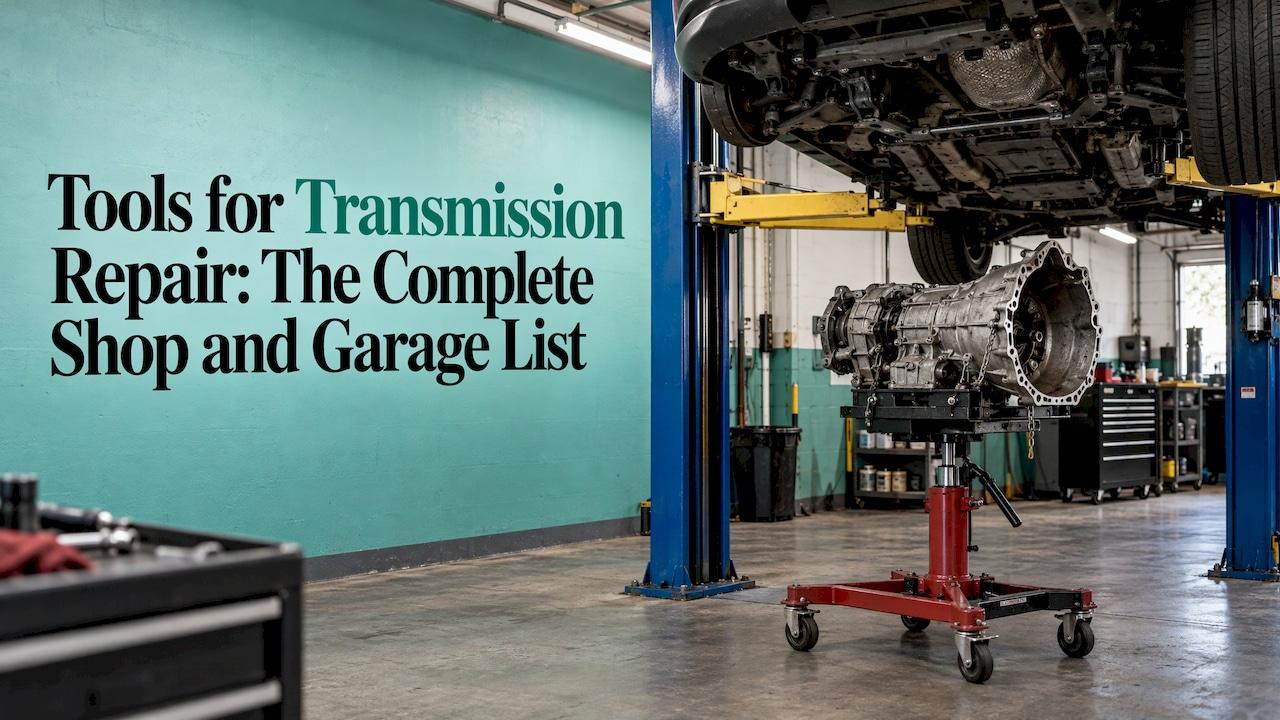
A transmission job needs four groups of tools: equipment to lift the vehicle and support the transmission, fluid-handling gear, diagnostic instruments, and the specialty tools that disassemble and reassemble the unit. Get the first group right and the job is safer and faster. Get the last one right and you avoid damaged parts. We supply the lifting and shop equipment side at Garage Equipments, with free shipping, a price-match guarantee and a 12-month warranty on all products.
TL;DR
- Lifting and support come first: a vehicle lift or floor jack, plus a transmission jack, since rear-wheel-drive vehicles with conventional transmissions may need a high-lift transmission jack.
- Fluid handling (drain pans, funnels, a fluid exchanger) keeps the job clean and repeatable.
- Diagnosis needs a multimeter, a scan tool and pressure testing, and a reading only means something when compared against exact vehicle information.
- Internal work calls for specialty tools such as snap-ring pliers, bearing drivers, pullers and holding fixtures, which manufacturers specify to prevent costly damage.
- Most of the same shop equipment also covers engine, suspension, brake and electrical work.
Table of Contents
- Start with lifting and support
- Fluid handling tools
- Diagnostic tools: find the fault before you pull the unit
- Specialty tools for disassembly and reassembly
- Build the kit in the right order
- Choosing durable tools
- Electric and hybrid vehicles
- What carries over to engine, suspension, brake and electrical work
- Where we fit
- Our view on transmission tooling
- FAQ
- Sources
Start with lifting and support
Before you touch a bolt, the vehicle has to be at a working height, held securely, and the transmission has to come down in a controlled way. A transmission weighs enough that trying to wrestle it off a creeper is how people get hurt and how housings and input shafts get damaged.
Vehicle lift or floor jack
For a DIY garage, a good floor jack with properly rated stands is the minimum. For a working shop, a lift changes the job: you stand upright, you reach the transmission, driveshaft and crossmember from below without crawling, and you free the floor. Our car lifts range includes portable options such as the 6000TLX portable car lift and the 8000TL portable car lift, as well as scissors lifts for shops with limited ceiling height or floor space. If you only need to get a wheel off the ground, our floor jacks cover that.
Whatever you choose, match the rated capacity to the heaviest vehicle you service, and never work under a vehicle held by a jack alone.
Transmission jack
The transmission jack is the tool that separates a transmission job from every other driveline job. It cradles the unit, lets you tilt and align it, and lowers it without you carrying the weight. Trade guidance notes that rear-wheel-drive vehicles with conventional transmissions may require a high-lift transmission jack, because the unit has to come out of a tunnel and drop well below the vehicle.
The things to look for are:
- Lift height that clears your vehicle on the lift or stands you use.
- Capacity above the weight of the heaviest transmission you will remove, including a torque converter and fluid left inside.
- Tilt and saddle adjustment, so you can line up the input shaft and bellhousing bolt holes without prying.
- Secure straps or chains so the unit cannot slide off the saddle.
Browse our transmission jacks by capacity and lift height. For electric and hybrid drivetrains, the Mobi-EVS transmission support is the support to look at.
Fluid handling tools
Transmission fluid goes everywhere if you let it. The basic kit is a wide, low drain pan or rolling oil drain, a set of funnels, and long-neck or fluid-drain funnels for refilling through a dipstick tube. Service guidance points out that fluid-drain funnels and rolling oil drains help collect fluid cleanly, which matters when you are working over a clean floor or a customer's vehicle.

For shops that do fluid services regularly, a dedicated machine changes the economics of the job. A transmission fluid exchanger replaces fluid in a controlled way rather than relying on gravity drain alone, and it makes a routine service something you can do in a predictable amount of time. If you also handle cooling-system work, the coolant exchangers category sits next to it.
Keep the work area clean. The Haynes workshop reference advises keeping the area as clean as possible, with mating faces clean and dry. A parts washer is the practical way to do that with cases, pans, valve body parts and fasteners before reassembly.
Diagnostic tools: find the fault before you pull the unit
The cheapest transmission repair is the one you do not do. Pulling a unit because of a sensor, a solenoid or a bad connector wastes hours. Trade guidance lists three diagnostic essentials: a high-end multimeter to test electrical problems such as solenoids and neutral safety switches, a scan tool for computer-controlled transmissions, and pressure testing of internal hydraulic pressures.
Multimeter
Solenoid resistance, supply voltage, ground integrity and switch continuity are all multimeter jobs. Use one with a good input rating and leads you trust, and compare readings against the specification for the exact vehicle.
Scan tool
Scan tools range from a low-cost code reader to a multi-thousand-dollar diagnostic system. A basic reader gets you fault codes. Live data, such as input and output speeds, line pressure command and commanded versus actual gear, is what tells you whether the unit is slipping or the controller is misreading a sensor. Always inspect the tool's leads for damage and follow the tool's instructions, and consult vehicle service information when needed.
When you road test with a scan tool connected, do not drive while watching the screen. The same training text says to use snapshot features or have a designated driver, and to avoid intrusive actuator tests while the vehicle is moving, since those can disable safety systems such as ABS.

Pressure gauge set
A hydraulic pressure gauge set connects to the transmission's test ports and shows what the pump and valve body are actually delivering. Low or unstable pressure points you inside the transmission. Normal pressure with a shifting complaint points you back to electronics or software.
One rule applies to all of these instruments: a measurement is not a diagnosis. It has to be set up correctly and interpreted against exact vehicle information, which means having the service data for the transmission in front of you.
Specialty tools for disassembly and reassembly
Once the transmission is on the bench, ordinary hand tools are no longer enough on their own. Manufacturers design special tools for the specific unit, and they exist because springs, snap rings, seals and bearings are easy to damage.
Eaton's service manual for Fuller heavy-duty transmissions recommends specialized tools because they make repair easier and faster and prevent costly damage to critical parts. The same manual lists snap-ring pliers, a mainshaft hook, a tension-spring driver, bearing pullers and drivers, a countershaft support tool, an input-shaft nut installer, an input-shaft bearing driver and a torque wrench. It also recommends flanged-end bearing drivers for installing bearings.
What the specialty tools do
| Tool | What it does | Where it shows up |
|---|---|---|
| Snap-ring pliers | Removes and installs retaining rings without distorting them | Shafts, clutch packs, bearing retention |
| Bearing pullers and drivers | Removes bearings and seats new ones squarely | Input, main and countershaft bearings |
| Mainshaft lifting hook | Lifts the mainshaft assembly out of and into the case | Manual heavy-duty units |
| Slide hammer | Pulls bearing races, idler shafts and seals | Case and housing work |
| Countershaft support tool | Holds the countershaft up during main box disassembly | Manual heavy-duty units |
| Seal drivers | Installs oil seals evenly in housings | Rear bearing housings, front pump |
| Torque wrench | Tightens fasteners to specification | Every reassembly |
Eaton's TRSM-2400 manual for FR and FRO transmissions names specific items, including a mainshaft lifting hook, a slide hammer with attachments, a hand maul and soft bar, and a countershaft support tool. Another Eaton manual, for the RTO-1258LL, RT-12509 and RT-12513 units, lists an auxiliary plate hanger bracket, an oil seal driver and a snap-ring installer, and describes an impact puller made from an 18-inch steel rod for reverse idler shafts.
The Fuller manual is also clear that it is not all exotic: ordinary mechanic's tools, a press, mauls and soft bars cover much of the disassembly and reassembly. The specialty tools handle the specific operations where a general tool would do damage.
Dual-clutch and modern automatics
Newer designs are less forgiving. Schaeffler states that work on dry double clutch systems must always be carried out with appropriate special tools to prevent damage to the clutch and transmission. Its system is built around a basic tool kit plus vehicle-specific kits, and the two are used together. For these units, buy the tooling that the manufacturer specifies before you open the case, not after.
Following the procedure
The service manual for your exact transmission is the document that says which special tools the job needs. If you ever depart from a manufacturer's procedure, Ford's service guidance is explicit that the technician must establish that the methods, tools and parts compromise neither personal safety nor vehicle integrity. Treat the manual as the tool list.
Build the kit in the right order
You do not need everything on day one. This order spends money where it prevents the most damage.
- Safe lifting and support. A lift or rated stands, a floor jack and a transmission jack. These protect you and the vehicle.
- Fluid handling. Drain pan, funnels, and an exchanger if you do the work regularly.
- Diagnostics. A multimeter, a scan tool with live data, and a pressure gauge set.
- Hand tools and a torque wrench. Sockets, extensions, a good breaker bar and a torque wrench you can rely on.
- Specialty tools for the units you actually work on. Add snap-ring pliers, pullers, bearing and seal drivers, and spring compressors as your jobs require them, using the manufacturer's tool list.
- Storage and cleaning. A tool storage setup and a parts washer keep small parts and special tools together and clean.
For a shop owner, this order also maps to payback: lifts and jacks speed up every job, while specialty tools pay off when you take on internal rebuilds.
Choosing durable tools
Tools that live in a working shop get dropped, loaded beyond what you intended and left near fluid and solvents. A few checks separate tools that last from tools you replace.
- Rated capacity with margin. For jacks and lifts, the rated capacity should exceed your heaviest job, not meet it exactly.
- Construction. Look at welds, pivot points, casters and hydraulic seals on jacks. Forged and hardened steel matters in pullers, drivers and pliers.
- Fit to your vehicles. Confirm the tool covers the transmissions you service, because specialty tooling is often vehicle-specific.
- Warranty and support. A written warranty covers the cost of a mistake. Everything we sell carries a 12-month warranty.
- Price. Compare total cost, including shipping. We offer free shipping and a price-match guarantee.
Electric and hybrid vehicles
If your work includes high-voltage vehicles, the rules change. Shop procedures for HV work should include lock out and tag out of electrical circuits, designated observers for people working on HV components, and a displayed emergency rescue plan, and insulated tools and PPE are subject to periodic testing and inspection. Do not start HV work without that training and those procedures in place.
What carries over to engine, suspension, brake and electrical work
Most readers who search for transmission tools also work on other systems, and much of the shop equipment overlaps.
- Engine repair. The lifting, support and cleaning equipment above carries straight over. Add engine-specific tools according to the job, from the service manual.
- Suspension repair. A lift gives access, and spring, ball joint and alignment tools are added by job. If you do alignments, look at our alignment lifts and alignment combo kits, and wheel lifts and wheel balancers for wheel service.
- Brake repair. Safe lifting and wheel service equipment come first, with brake-specific tools added by job.
- Electrical work. The same multimeter and scan tool you use for transmission diagnosis do most of the work. Electrical diagnosis follows the same rule: compare readings to vehicle information.
- Home car repair. A floor jack, stands, a torque wrench and a decent tool storage unit cover the common jobs, and you add from there.
Browse the full shop equipment category to see how these pieces fit together.
Where we fit
If you are building or upgrading a garage, our focus is the heavy equipment that every drivetrain job depends on: lifts, jacks, transmission jacks, fluid exchangers, wheel service equipment, parts washers and storage. We serve professional mechanics, shop owners and DIY users. Every product comes with free shipping, a price-match guarantee and a 12-month warranty, and we pay attention to customer service, because a lift or a jack is a purchase you want to feel sure about.

Start with the transmission jacks and car lifts, or see everything at Garage Equipments.
Our view on transmission tooling
We think a transmission job is decided before the first bolt comes out. If the vehicle is at a comfortable height, held securely, and the transmission has a proper jack under it, the work is calmer and the parts survive. That is why we put lifts, floor jacks and transmission jacks at the centre of what we offer.
We also believe the right tool matters most where the cost of a mistake is highest: lifting heavy units, handling fluids cleanly and keeping parts organized. Shop equipment that is built to last and backed by a 12-month warranty, shipped free and price-matched, lets mechanics and DIY users put their money into the specialty tools that their particular jobs demand.
Build in order: support first, fluids second, diagnostics third, specialty tools by job. Every piece you add then pays for itself.
the author
FAQ
What basic tools do I need to repair a transmission?
You need a way to lift and support the vehicle, a transmission jack, drain pans and funnels, a multimeter and scan tool for diagnosis, a torque wrench, and hand tools. Internal repairs add specialty tools such as snap-ring pliers, bearing drivers and pullers. The service manual for your transmission lists the special tools it requires.
Do I need a transmission jack, or can a floor jack do the job?
A transmission jack is built to cradle, tilt and lower the unit, which is what the job requires. Rear-wheel-drive vehicles with conventional transmissions may need a high-lift version to clear the tunnel. A floor jack is a good general tool for lifting the vehicle, and the transmission jack is the tool for the transmission itself.
Which tools help diagnose a transmission problem?
A multimeter checks solenoids and switches, a scan tool reads codes and live data on computer-controlled transmissions, and a pressure gauge set shows hydraulic pressure inside the unit. Compare every reading against the exact vehicle's specifications, since a measurement alone is not a diagnosis.
Are special tools really necessary, or can I improvise?
Manufacturers specify special tools to make repairs easier and faster and to prevent damage to critical parts. Dual-clutch systems in particular call for the correct tooling. Use the tools your service manual lists, and if you depart from the procedure, you are responsible for making sure safety and vehicle integrity are not compromised.
Can the same equipment be used for engine, suspension and brake work?
Yes, lifts, jacks, parts washers and storage serve every system. Each job then adds its own specific tools according to the service manual.
Sources
- Tools and Equipment Needed for Transmission Service, Tire Review
- Fuller Heavy Duty Transmissions service manual, Eaton
- Eaton Fuller HD FR/FRO transmissions service manual, TRSM-2400
- Service Manual RTO-1258LL, RT-12509, RT-12513, Eaton
- The dry double clutch, Schaeffler Automotive Aftermarket
- Automotive Tool Library, IAR
- Ford service tip, 2023 6.7L Power Stroke
- Scan tool chapter sample, Goodheart-Willcox
- High-voltage safety chapter sample, Goodheart-Willcox
- Tools and Working Facilities, Haynes reference