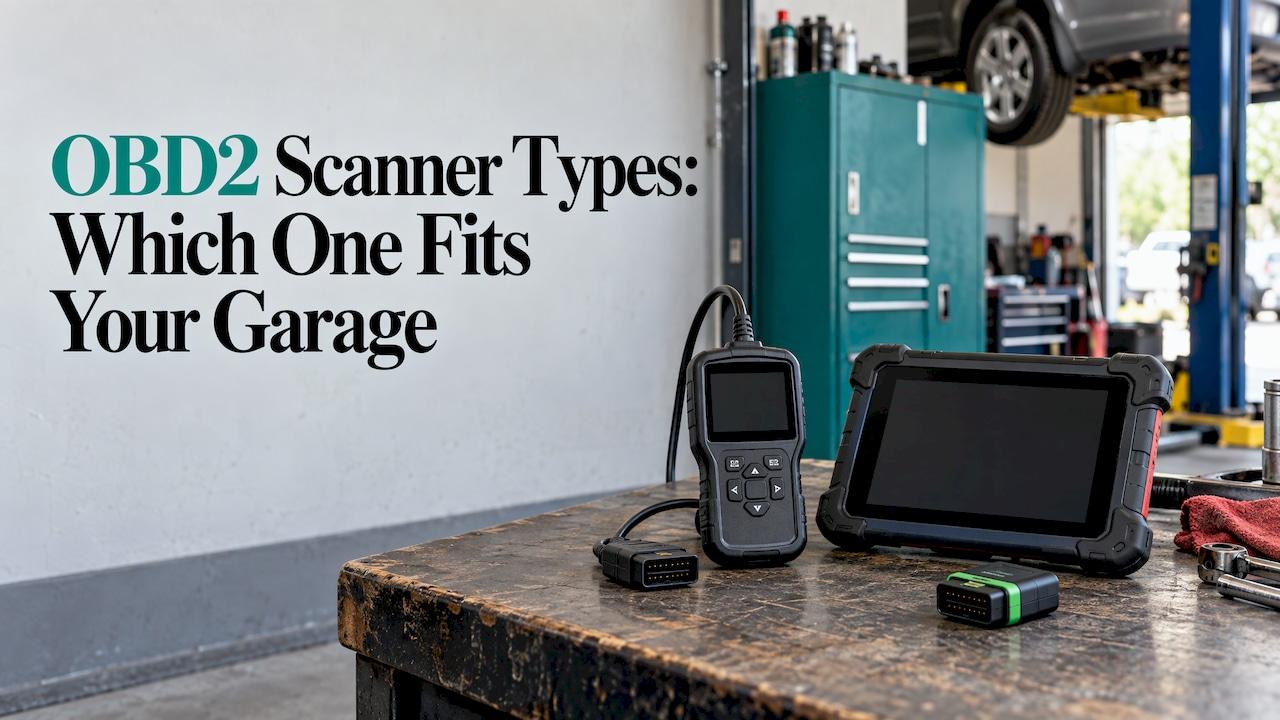
There are five kinds of OBD2 scanner: the basic code reader, the Bluetooth or Wi-Fi adapter, the handheld scan tool with its own screen, the tablet-style scanner and the professional platform. Match the type to the work you actually do. A code reader is enough to read and clear a check engine light. Once you need ABS, airbag, service resets or tests that command parts to move, you need a bi-directional scan tool. A shop that works on many makes needs a tablet or professional platform. Garage Equipments supplies diagnostic scanners alongside the lifts, wheel service gear and shop equipment that a working bay needs, with a 12-month warranty on all products, free shipping and a price-match guarantee.
TL;DR
- Code readers read and clear engine codes. Adapters put the screen on your phone. Handhelds and tablets add other modules and service functions. Professional platforms add coding and programming.
- The real dividing line is bi-directional control: the ability to send commands to the car, not only read from it.
- Any gasoline car or light truck from model year 1996 on, and diesels from 1997, is required to have OBD II, so the port is not the issue. Coverage of each make's modules is.
- Published price tiers run from about $20 for a simple reader to $2,000 for a professional scanner.
- Buy for the vehicles you service most, and for the functions you will use weekly, not the longest feature list.
Table of Contents
- What an OBD2 scanner actually does
- The five OBD2 scanner types
- Side by side
- The line that matters most: reading versus commanding
- Which type fits which reader
- What to check before you buy
- A worked example
- Our perspective
- Equip the bay around your scanner
- FAQ
- Sources
What an OBD2 scanner actually does
Every modern car has a diagnostic port, usually under the dashboard on the driver's side. A scanner plugs into it and talks to the vehicle's computers. When a computer detects a fault it stores a diagnostic trouble code (DTC), a short alphanumeric code that points to the circuit or system at fault. The scanner reads that code, and the better ones show you what the car was doing when it set.
The port is standard across the US market. The California Air Resources Board states that all 1996 and newer gasoline and alternate-fuel passenger cars and trucks, and 1997 and newer diesels, must have OBD II. The same page explains that the federal EPA requires 1996 and newer cars and trucks sold in any state to meet its OBD requirements. So a cheap scanner will physically connect to almost any car you are likely to own.
What differs between scanner types is how much they can say once connected. Generic, emissions-related data is standardized. Everything else, such as body control, ABS, airbags and transmission detail, depends on the tool's coverage of that manufacturer.

The five OBD2 scanner types
The grouping below follows the common buyer's breakdown into five main scanner types, each described with what it does in daily use.
1. Basic code readers
A code reader is a small handheld with a cable and a simple display. It reads and clears engine codes and shows basic live data. There is no phone, no app and no setup.
Older guidance splits the market into two groups: inexpensive code readers and more expensive scan tools. The readers typically lack manufacturer-specific code information and give limited or no access to other data.
What you get in practice: the standard SAE codes, a way to turn off the check engine light, emissions readiness status and some indication of how severe a code is, according to ALLDATAdiy's scan tool guide.
Best for: a glovebox tool, a pre-purchase check on a used car, or a quick look before an emissions inspection.
2. Bluetooth and Wi-Fi adapters with a phone app
This is a small plug that stays in the port and sends data wirelessly to an app on your phone or tablet. The app is the screen. That makes it cheap and convenient, and it can log data while you drive.
The trade-offs sit in the software. What you can see depends on the app and on a stable phone connection, and some apps lock features behind a paid upgrade. Before buying, check that the app runs on your phone and lists your make and the systems you care about.
Best for: DIY owners who like data, who want to watch live readings on a road test, and who already know which app they trust.
3. Handheld scan tools with their own screen
A handheld is a rugged, self-contained tool with a built-in screen and buttons. It does not depend on a phone, a battery you forgot to charge or a Wi-Fi network in a noisy bay. Many read more than the engine, including ABS and airbag systems, and perform service resets.
In ALLDATAdiy's description, intermediate tools of this class add freeze frame data (a snapshot of conditions when the fault set), communication with ABS and transmission modules, PID data (live sensor values), basic graphing, stored and pending codes, monitor status, limited bi-directional commands and maintenance light resets.
Best for: a home garage that does its own brakes, oil services and sensor swaps, and for a mechanic who wants a tool that survives a drop on concrete.
4. Tablet-style scanners
A tablet scanner is a larger Android-based screen with a rechargeable battery and Wi-Fi updates. The big display makes graphs, menus and long procedures far more comfortable to follow. It is a natural step up when the handheld screen becomes the bottleneck.
Best for: independent shops and serious enthusiasts who spend hours per week on diagnostics and want a clear workflow from code to test to reset.
5. Professional platforms
These are built for shops. They cover many makes, run deeper tests and offer coding and programming. They often need a laptop, a vehicle interface and a subscription.
ALLDATAdiy describes professional tools as adding full bi-directional commands, such as energizing relays and solenoids, operating pumps and motors and activating brake components. They also add calibrations, charging system testing, network self-tests, PCM updates, component relearns, DPF regeneration, live data record and playback, diagnostic guidance and internet access to service information.
Best for: shops that take on mixed-brand work, and technicians who program modules or replace components that must be relearned.
Side by side
| Type | Screen | What it does well | Where it runs out | Published price tier |
|---|---|---|---|---|
| Basic code reader | Built in, small | Reads and clears engine codes, readiness | Little beyond the engine | $20 to $35 |
| Bluetooth or Wi-Fi adapter | Your phone | Cheap, portable, data logging | Depends on app, phone and paywalls | Varies by app |
| Handheld scan tool | Built in | ABS, airbag, resets, durable | Limited bi-directional | $50 to $300 |
| Tablet-style scanner | Large Android screen | Comfort, updates, graphs | Deeper programming still needs more | Mid to upper tier |
| Professional platform | Tablet or laptop | Full bi-directional, coding, programming | Cost, subscriptions | $500 to $2,000 |
The price tiers above come from ALLDATAdiy's pricing breakdown: $20 to $35 for simple code readers, $50 to $300 for intermediate scanners, $500 to $2,000 for professional scanners, and $20,000 or more for dealership-level tools, which also need subscriptions for manufacturer information and software. The guide was published in 2023, so treat the ranges as a map of the market, not a quote. Adapter and tablet pricing overlaps these tiers, so we left those cells open instead of inventing a band.
The line that matters most: reading versus commanding
Most buyers compare screens and brands. The more useful comparison is whether the tool is bi-directional.
A code reader only retrieves and displays trouble codes. A bi-directional scan tool retrieves information from the vehicle's computer and also sends data to it. It can operate output devices such as idle air motors and EGR solenoids directly, and it can force the engine computer to run tests it would not otherwise run.
Why this matters at the bench: a code says a circuit is wrong. It does not say whether the part, the wiring or the computer is at fault. A command that cycles a solenoid, runs a fuel pump or fires a cooling fan lets you test the part while you watch live data. That shortens the guesswork, and it is the reason shops pay more for tools that can do it.

Which type fits which reader
Casual DIY owner
If you want to know why the check engine light came on and whether the fix is a gas cap or a trip to the shop, a code reader or a good adapter is enough. Read the code, look up what it means, clear it after the repair.
Serious DIY enthusiast
If you do your own brakes, suspension and sensor work, a handheld or tablet scanner earns its price. Look for ABS and airbag access and service resets such as electronic parking brake, oil life and steering angle.
Professional mechanic
Check for bi-directional controls, live data graphing and wide make coverage. Time at the vehicle is what you are buying, so a clear screen and fast updates count.
Shop owner
You are buying for several technicians and many makes. Coverage is the key factor: Vehicle Service Pros notes that some scan tools perform strongly on certain car lines and weakly or not at all on others. Its advice is to pick the tool that gives the most value across your work and to be ready to add a second tool for specific lines. Pull your last three months of repair orders, count the makes, and buy for that mix.
What to check before you buy
- Vehicle coverage. Confirm the make, model, year and engine you work on most. Generic coverage of engine codes is universal, but ABS, airbag, body and transmission access is not.
- Functions you will use weekly. Service resets, bi-directional tests, live data and freeze frame. Ignore a function you will use once a year.
- Screen and power. A tablet screen helps with long jobs. A handheld without a battery to charge is faster to grab.
- Updates and subscriptions. Ask what updates cost after the first year, and whether features are unlocked per make.
- Durability. In a bay, tools get dropped, oiled and kicked. A rugged case and a strong cable matter more than a thin spec sheet.
- Warranty and support. A diagnostic tool is a working asset. A 12-month warranty and a seller who answers questions are part of the price.
A published overview of 2026 products, the Scan Tool Spec Guide from Vehicle Service Pros, covers specifications from 20 aftermarket manufacturers and more than 40 tools across Global OBD-II, Professional Diagnostic and Heavy Duty Diagnostic categories. It shows how wide the market is, and why matching coverage to your vehicles beats chasing the biggest feature count.
A worked example
Say a customer's 2014 pickup has the check engine light on and the ABS light too.
- A code reader shows an engine code, for example a misfire. It cannot see the ABS module, so the second light stays unexplained.
- A handheld reads the engine code and the ABS code. You find a wheel speed sensor fault and a lean condition from a vacuum leak.
- A tablet or professional tool does both, then runs an ABS bleed or a relearn after the repair, and logs live data to show the customer the before and after.
Same truck, same port, three different amounts of information. The right scanner is the one that closes the job without a second tool.
Our perspective
We sell equipment to people who make a living in the bay and to people who want their own garage to work like one. Across both, the best buying decision starts with the work, not the tool.
A scanner is one part of a diagnostic workflow. It works best next to the equipment that lets you act on what it finds: a lift that gets the car to working height, a wheel balancer and tire changer for the wheel service that follows a suspension code, and storage that keeps the tools where you can find them.
That is why we put durable machinery from top brands, a 12-month warranty on all products, free shipping and a price-match guarantee behind every item. Buying diagnostic and shop equipment from one supplier means one place to ask questions and one warranty standard across the bay.
the author
Equip the bay around your scanner
Diagnosis is the first half of the job. Once the scanner points to a worn suspension part, a brake fault or a tire issue, you need the equipment to fix it. Garage Equipments carries diagnostic scanners together with car lifts, wheel service equipment and shop equipment, for professional mechanics, DIY users and shop owners. Every product carries a 12-month warranty, shipping is free and our price-match guarantee applies.

Browse the full range at Garage Equipments and choose the scanner and the lift, balancer or storage that fit your work.
FAQ
What are the main types of OBD2 scanners?
There are five: basic code readers, Bluetooth or Wi-Fi adapters used with a phone app, handheld scan tools with their own screen, tablet-style scanners and professional platforms. They differ in what systems they read, whether they can command components, and how they are powered and updated. Price rises along with capability.
What cars do OBD2 scanners work on?
Gasoline cars and light trucks from model year 1996 on, and diesels from 1997, are required to have OBD II. A scanner will connect to them. How much it can read beyond engine data depends on the tool's coverage of that make.
Is it worth buying an OBD2 scanner?
For most owners, yes. A basic reader sits at the low end of published price tiers, around $20 to $35 according to ALLDATAdiy, and it tells you what the check engine light means before you decide on a repair. If you work on cars regularly, a handheld or tablet tool adds modules and resets that save time.
What is the difference between a code reader and a scan tool?
A code reader retrieves and displays trouble codes. A scan tool is bi-directional: it also sends commands to the vehicle and runs tests. That lets you check a part by operating it, not just infer its state from a code.
Do I need a professional scanner for my home garage?
Usually not. Published guidance leaves dealership-level tools out of DIY advice because they are very expensive. A handheld or tablet scanner in the intermediate tier covers most home work, including ABS reads and service resets.
Sources
- California Air Resources Board: OBD II systems fact sheet
- ALLDATAdiy: OBD-II scan tools
- How to choose an OBD2 scanner: buyer's guide (2026)
- Benefits and types of OBD-2 devices
- G-W textbook chapter on OBD II scan tools
- Vehicle Service Pros: a systematic approach to finding the right scan tool
- 2026 Scan Tool Spec Guide