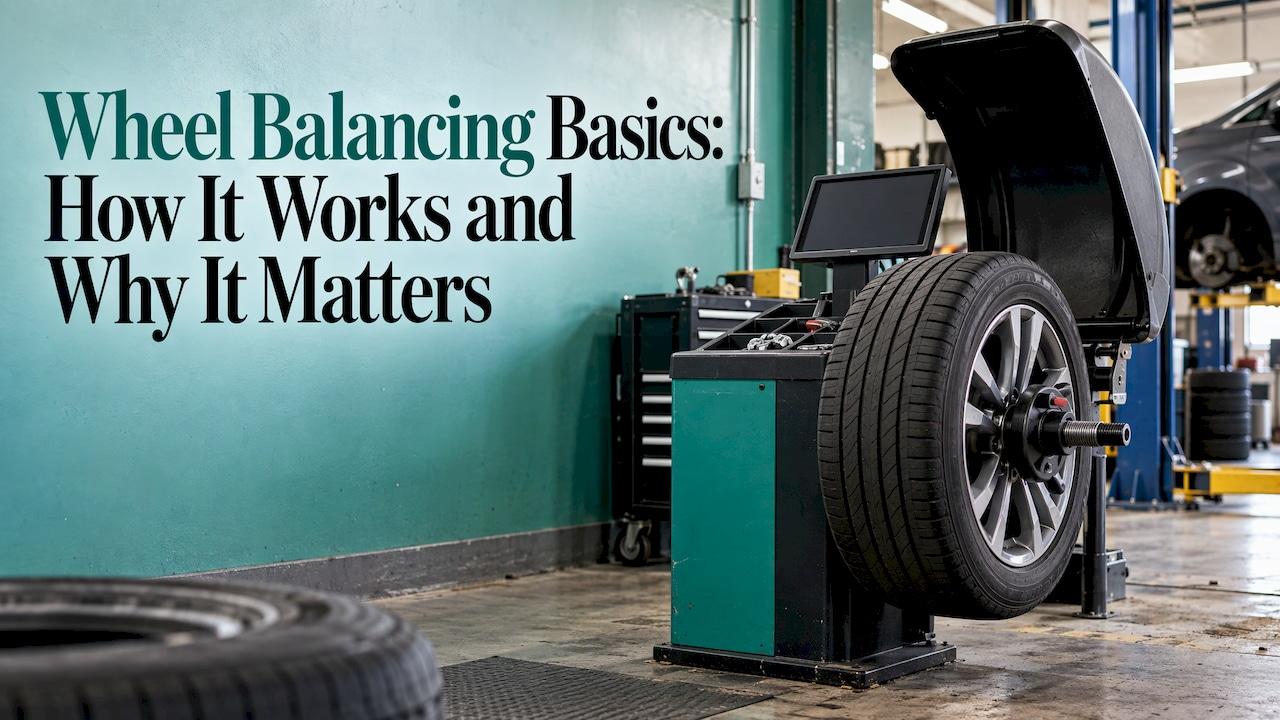
Wheel balancing corrects uneven weight distribution in a wheel-and-tire assembly so it spins smoothly at speed. A balancer measures where the assembly is heavy, and you add small weights to the rim to offset it. The machine does the measuring, but the result depends on a clean, correctly centered mount and a verification spin. That is why a good balancer and good technique matter more than any trick. If you run a shop, work on your own cars or want to know what your tires need, this guide covers the process from the first spin to the last check.
TL;DR
- Balancing adds small counterweights to the rim so the heavy spot of a tire-and-wheel assembly no longer causes vibration at speed.
- Every new tire installation needs it, and wheels can drift out of balance later from potholes, wear, lost weights or poor storage.
- The process is: clean, mount on the correct cone, enter wheel dimensions, spin, place weights at the indicated position, then re-spin until the readings are zero.
- Balancing fixes how a wheel rotates. Alignment fixes where the wheel points. They are separate jobs, and you need both.
- Mounting accuracy and the right balancer are what make results repeatable. Our wheel balancers come with free shipping, a price-match guarantee and a 12-month warranty.
Table of Contents
- What wheel balancing actually does
- What throws a wheel out of balance
- Static and dynamic imbalance
- The wheel balancing process, step by step
- Signs your wheels need balancing
- How often to balance
- Balancing vs. alignment
- What balancing costs, and what that means for a shop
- What to look for in a wheel balancer
- Promo: balancers for the shop or garage
- Our perspective
- FAQ
- Sources
What wheel balancing actually does
No tire-and-wheel assembly is perfectly uniform. Tires and wheels are not perfectly round, so the assembly's center of gravity rarely sits exactly on its geometric center, as Discount Tire's balancing guide explains. The goal of balancing, in Continental's words, is to distribute weight equally around the entire circumference.
The heavy spot matters because of speed. A tire can look round and true when you turn it by hand, but at speed centrifugal force throws the heavy area outward. Continental puts numbers on it: a 10 g (0.35 oz) weight difference produces a force of 2.5 kg (5.51 lb) at 100 km/h, about 62 mph. A few grams at the rim become a pulse you feel in the steering wheel.
Balancing does not make a wheel perfect. The Drive's guide notes a wheel can never be 100% balanced. The aim is to bring it within spec so the imbalance no longer causes problems.
What throws a wheel out of balance
Some imbalance is built in. Wheels vary slightly in production, and valve stems and TPMS sensors add weight at one point. Tires have their own manufacturing variation. The Drive lists all of these as reasons an assembly starts out unbalanced.
Other causes show up over the life of the wheel. Continental lists:
- hard braking or sharp cornering
- potholes or other obstacles that deform wheels
- the tire valve's own weight
- improper storage
- radial or lateral runout in new tires, which is corrected by "matching"
Pirelli adds that uneven tire wear, a dented rim or a lost balancing weight can do it too, and that deviations under 10 grams can be enough. The Drive also points out that heat or G-forces can loosen weights, especially in track use. So a balance job is not permanent.
Storage and flat spots
A tire that sits under load in one position can pick up a flat area, and that is one way storage ends up in the list of causes. If you keep seasonal wheels or a car through the winter, preventing tire flat spots in storage is worth reading before the wheels go back on the vehicle. Even so, rebalance wheels when they come out of storage and are remounted.

Match mounting
Runout means the tire or wheel is slightly out of round. Match mounting corrects for it by lining up the tire's high point with the wheel's low point, per Discount Tire. That reduces how much weight the balancer has to add. Pirelli also describes rotating the tire on the rim to offset aligned heavy spots. A well-matched assembly needs less lead, and less lead means less to fall off.
Static and dynamic imbalance
Two kinds of imbalance explain why modern balancers do what they do.
Static imbalance is a heavy spot in the plane of rotation. It makes the wheel hop up and down. A US military technical manual describes it this way, and notes that the old bubble balancer, still common in some places, checks only static balance.
Dynamic imbalance is weight that sits on one side or the other of the tire's center line. It causes wheel shimmy or wobble, according to the same manual. You cannot find it with the wheel at rest, because it only shows up while the wheel is spinning.
Tire Review's 2026 shop guide describes the two methods this way:
| Method | How it works | What it corrects |
|---|---|---|
| Static balancing | The assembly sits on a spindle, the heavy portion rotates downward, and a small weight goes opposite | Up-and-down hop in one plane |
| Dynamic balancing | The assembly spins at roughly 10 to 60 mph while sensors detect irregularities; the computer calculates weight amounts and placement for the inner and outer rim planes | Both hop and side-to-side wobble |
Shops use dynamic balancing for passenger cars. It is why a modern balancer asks for two weights per wheel, one inboard and one outboard.
The wheel balancing process, step by step
This is the standard sequence, drawn from Tire Review's step-by-step guide and the shop practices behind it. At each step, there is a way it goes wrong.

1. Check the tire seating and pressure
Before anything else, confirm the tire is seated concentrically on the wheel. Tire Review says to reseat it if the sidewall-to-flange measurement exceeds 2/32 inch, and to inflate to the recommended pressure. A tire that is not seated evenly will read as imbalance, and the weights you add will be wrong the moment the tire settles.
2. Clean the wheel and remove old weights
Take off every old clip-on or stick-on weight, plus any dirt, mud or residue in the center bore and on the mounting surface. AAA's description of the job also starts with removing the old weights before the assembly is spun. Leftover adhesive or grit throws off both the measurement and the way the new weights stick.
3. Mount on the spindle with the right cone
Use the correct centering cone for the wheel and clamp it firmly. This step causes more false readings than any other. Tire Review's David Sickels warns that damaged cones or collets, worn springs or shafts, and a cone that does not match the wheel's structural taper can produce false readings. That is common on modern alloy wheels without a simple tapered center bore. The result is a technician who keeps adding weights chasing a number that will not settle.
4. Enter the wheel dimensions
The balancer needs the wheel's offset (distance), diameter and width. Enter them from the wheel or measure them with the machine's gauge arm. A wrong dimension means the machine places the correction in the wrong plane, so the weights it calls for do not do the job.
5. Spin and read the imbalance
Lower the guard and run the cycle. Tire Review describes an 8 to 10 second spin. The machine reports the amount and position of the imbalance for the inner and outer planes.
6. Apply the weights
Rotate the wheel to the position the balancer indicates, usually the 12 o'clock position, and attach the specified inboard and outboard weights. Which weight type depends on the wheel. Michelin's guidance says that on steel rims, weights hook onto the flanges, while on aluminum rims adhesive weights go behind the spokes to avoid damaging the rim.
7. Verify with a second spin
Lower the guard and spin again. The wheel is balanced when the readings show zero. Tire Review also notes that a repeat check showing different weight amounts or locations signals that the wheel was not mounted properly, so go back to step 3 rather than adding more lead.
What "balanced" means in numbers
Shops commonly work to a residual imbalance of 0.25 oz, roughly the weight of a US quarter, and Performance Plus Tire says premium shops release wheels at 0.10 oz or less. The article also names four things that decide the quality of a balance: the type of balancer (basic spin or road force), how tight the tolerance setting is, whether the technician verified after applying weights, and whether the wheels were match-mounted for runout. Those variables are all within a shop's control, and most are tied to the equipment.
Signs your wheels need balancing
AAA lists the common symptoms:
- vibration in the steering wheel, seat or floor above about 45 mph
- uneven tire wear
- reduced fuel efficiency
- less responsive handling
- suspension damage over time
Continental narrows the vibration window to roughly 50 to 70 mph and adds feathered or scalloped tread wear and unusual road noise. If a vibration appears at one speed and fades above or below it, imbalance is a likely cause.
Ignoring it costs more than tires. The Drive says poorly balanced wheels wear bushings, wheel bearings, tie rod ends and other suspension parts prematurely, and that those failures could lead to loss of vehicle control.
How often to balance
Balance every wheel whenever a tire is fitted. Michelin says dynamic balancing should be carried out systematically whenever tires are replaced or refitted. After that, Continental suggests rebalancing every 5,000 to 10,000 km (about 3,100 to 6,200 miles) or every 1 to 2 years. Pirelli's guidance says not to go more than two years without rebalancing, and to check yearly if you drive on rough roads. It also recommends balancing when you rotate tires or align the wheels.
Rebalance sooner after a hard pothole hit, a repaired tire, or any time a vibration appears.
Balancing vs. alignment
People mix these up constantly, and customers do too. Michelin USA draws the line clearly: balancing ensures the assembly spins evenly at speed, while alignment adjusts the wheel angles to the manufacturer's specifications so the tires meet the road correctly.
| Wheel balancing | Wheel alignment | |
|---|---|---|
| What it fixes | Uneven weight distribution in the tire-and-wheel assembly | The angles of the wheels relative to the car and road |
| Done with | A balancing machine and small weights | Suspension adjustments to factory specs |
| Typical symptom | Vibration at highway speed | Pulling to one side, off-center steering wheel, uneven edge wear |
| Adjusts | Weight at the rim | Camber, toe and caster |
AAA describes the three angles: camber is the inward or outward tilt seen from the front, toe is whether the tires face straight ahead when the steering wheel is straight, and caster is the steering-component angle that affects cornering and steering.
The practical point from Michelin is that a vehicle can be perfectly aligned and still vibrate from imbalance, and a balanced wheel can still wear unevenly if the angles are off. Neither service substitutes for the other.
What balancing costs, and what that means for a shop
For shop owners, the numbers matter. Performance Plus Tire puts retail pricing at $15 to $30 per wheel for a standard balance and $40 to $80 for road force balancing. That is per wheel, four wheels per vehicle, on nearly every tire job. A balancer is a machine that earns its place by being used on every tire installation, so reliability, accuracy of the mounting hardware and long service life count for more than any single spec.
For a home garage, the picture is different. Rotating tires is simple enough for a DIY owner, while balancing, as Pirelli notes, is a more complex process that requires specialized equipment. If you mount your own tires, a balancer completes the job so the new tire does not leave you with a vibration you cannot trace.
What to look for in a wheel balancer
The process above tells you what the machine has to do well:
- Accurate, repeatable mounting. Cones, collets and shafts that hold the wheel dead center, with the cone range to fit modern alloy wheels.
- Dynamic balancing on two planes. Inner and outer weight calculation is how you correct both hop and wobble.
- Support for the weight types you use. Clip-on weights for steel wheels and adhesive weights for alloys.
- A verification spin that confirms zero. The final check is where a good result is proven.
- Warranty and support. A machine that runs every day needs backup if something goes wrong.
Promo: balancers for the shop or garage
If you are ready to do this work yourself, whether in a professional bay or a home garage, start with our wheel balancers. They sit in our wheel service range with free shipping, a price-match guarantee and a 12-month warranty on all products.

If you are building out a full tire bay, the wider wheel service category covers the rest of the wheel work, and our guide to how tire changers work shows how the mounting stage that comes before balancing is done.
Our perspective
Most vibration complaints we hear about come back to the same two things: a tire that was not mounted square on the balancer, or a balancer that was not up to the daily job. The measuring is the easy part. The discipline is in the clean wheel, the right cone, the correct dimensions and the second spin.
That is why we put reliability and durability first when we choose the machines we supply. A balancer that holds its accuracy over thousands of spins saves a shop from comebacks and saves a DIYer from chasing a vibration that was never in the wheel.
We back what we sell with a 12-month warranty, free shipping and a price-match guarantee, and our customer service is there for questions about which machine fits your bay, your wheels and your volume.
the author
FAQ
What is the process of wheel balancing?
The assembly is cleaned, stripped of old weights and mounted on the balancer's spindle with the correct cone. You enter the wheel's offset, diameter and width, then spin it so the machine measures the imbalance. You attach weights where it indicates and spin again until the readings show zero.
How much does it cost to balance a tire?
Performance Plus Tire reports retail prices of $15 to $30 per wheel for a standard balance and $40 to $80 for road force balancing. Prices vary by region and shop, so treat those as a range rather than a quote.
Is balancing the same as alignment?
No. Balancing corrects weight distribution so the wheel rotates evenly. Alignment sets the camber, toe and caster angles so the wheels point and contact the road correctly. A car can have one problem without the other.
How do I know my wheels are out of balance?
The classic sign is vibration in the steering wheel, seat or floor at highway speed, often starting around 45 to 50 mph. Uneven or scalloped tire wear and unusual road noise are other signs.
Can wheel balancing be done at home?
Yes, if you have a wheel balancer and follow the same steps a shop uses: clean the wheel, mount it on the right cone, enter the dimensions, spin, apply weights and verify. The quality of the machine and the mounting hardware decides how repeatable the result is.
Sources
- Balancing tires, Continental Tires
- What is Wheel Balancing?, The Drive
- Tire Balancing, Discount Tire
- How do I know if my tyres need to be balanced?, Pirelli
- Pirelli maintenance guidance, Switzerland
- Wheel Balancing, US military technical manual
- Wheel Balancing Guide for Tire Shops, Tire Review
- How to Balance a Wheel: Essential Steps, Tire Review
- Wheel alignment, wheel balancing, Michelin
- Wheel Alignment & Balancing Explained, Michelin USA
- Wheel Balance vs. Alignment, AAA
- Are Wheel and Tire Packages Balanced?, Performance Plus Tire
- How to Prevent Tire Flat Spots in Storage