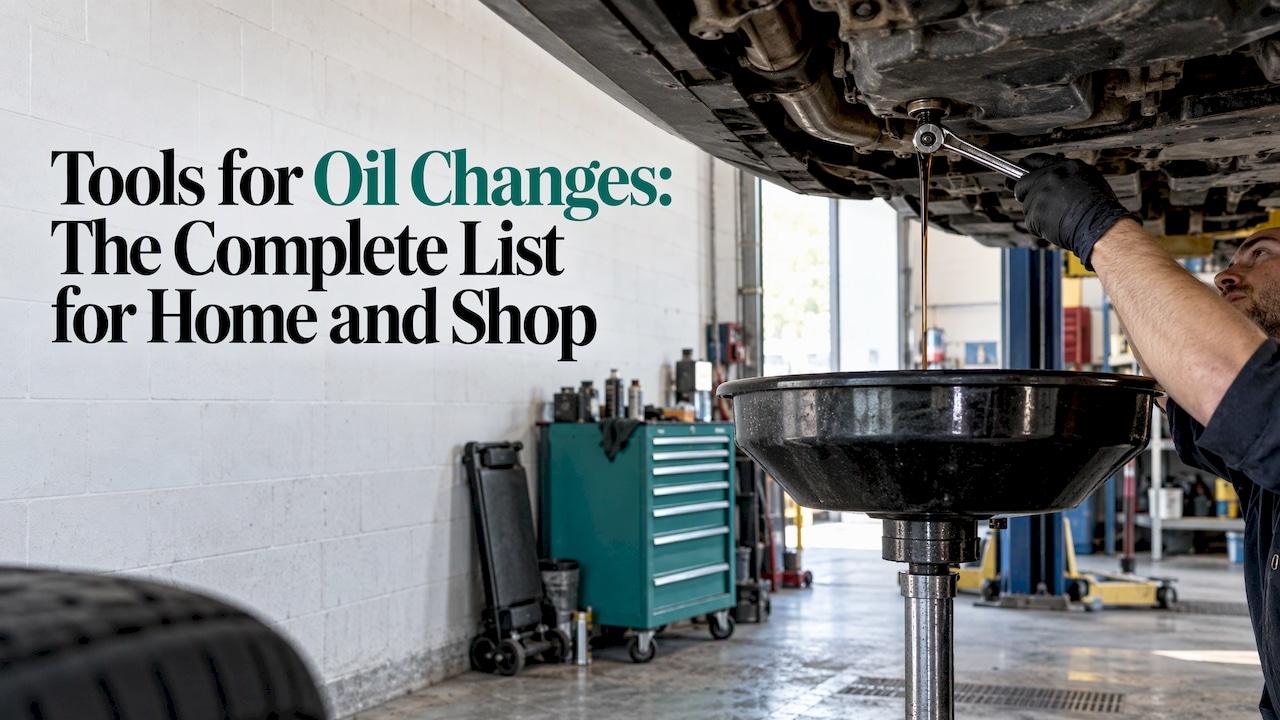
A basic oil change takes a way to lift the vehicle safely, a wrench or socket for the drain plug, an oil filter wrench, a drain pan, a funnel, gloves and rags. Add a torque wrench if your filter is a cartridge type, and a lift if you change oil often enough that crawling under a car gets old. Here is what each tool does, how to pick the right version for your vehicle, and where a shop or serious home garage should spend more.
TL;DR
- The core kit is a jack with jack stands or ramps, a socket or wrench for the drain plug, an oil filter wrench, a drain pan, a funnel, gloves and rags.
- Match the filter wrench to the filter: strap wrenches fit most canister filters, cap wrenches fit one size well, and cartridge housings need a specific socket plus a torque wrench.
- Never work under a car held up by a jack alone. Use jack stands, purpose-made ramps or a lift.
- A decent drain pan and funnel cost little. The money belongs in safe lifting and in tools you will use for years.
- Shops and busy home garages get the most from a car lift, which removes the jack-and-stands routine from every service.
Table of Contents
- The basic oil change tool kit
- Getting the vehicle up safely
- The drain plug tool
- Choosing an oil filter wrench
- Drain pan and funnel: size and design
- Optional tools that make the job cleaner
- What oil change tools cost
- Safe handling and disposal
- Tools for a shop that does oil changes every day
- Our view: buy the lifting gear once
- Equip your bay
- FAQ
- Sources
The basic oil change tool kit
Edmunds lists the essentials for a DIY oil change as a floor jack or ramps, jack stands, a drain-plug wrench or ratchet and socket, an oil filter wrench, a drain pan and a funnel. Gloves and paper towels are consumables. The oil, a new filter and a new drain-plug washer are supplies, not tools, but you need them on the bench before you start.
That list is short on purpose. An oil change is one of the simplest jobs on a car, and the tools are not exotic. What separates a clean 30-minute job from a messy afternoon is choosing the right version of each one.
| Tool | What it does | What to look for |
|---|---|---|
| Jack and jack stands, or ramps | Raises the vehicle and holds it safely | Rated for your vehicle's weight, stable on level ground |
| Socket set or combination wrench | Removes the drain plug | The exact plug size, ideally a 6-point socket |
| Oil filter wrench | Breaks loose and tightens the filter | Type matched to your filter and the space around it |
| Drain pan | Catches the old oil | Capacity larger than your engine's oil capacity |
| Funnel | Guides new oil into the fill port | Fits the fill port, ideally flexible or offset |
| Torque wrench | Tightens plugs and housings to spec | Needed for cartridge filter housings |
| Gloves, safety glasses, rags | Protect you and the garage floor | Nitrile gloves, glasses worn when draining |
Getting the vehicle up safely
This is the part of the kit where cutting corners costs the most. Edmunds is blunt: use a jack with safety stands or purpose-made ramps, and never rely on the flimsy jack supplied with the car. A jack lifts. It does not hold. Stands or ramps hold.
A few habits go with the equipment:
- Work on a solid, level surface, such as a concrete floor.
- Chock the wheels that stay on the ground.
- Set the stands under the manufacturer's lift points, not under suspension parts or the oil pan.
- Give the car a firm push before you slide underneath, to confirm it is stable.
Ramps are the quickest option for oil changes because there is nothing to position under the car, but they limit what you can reach. Jack stands give you more room and let you remove a wheel when a job calls for it. A floor jack with stands takes longer to set up each time, and that setup time is exactly what a lift eliminates.
The drain plug tool
Most drain plugs take a socket on a 3/8-inch-drive ratchet or a combination wrench. Car and Driver lists a basic wrench and ratchet and socket set as the starting point. Some vehicles use plugs that need a hex or Torx bit instead, so check the plug before you buy anything.
Two practical points:
- Use a 6-point socket rather than a 12-point where you can. It grips the flats of the plug and is less likely to round it off.
- Replace the drain-plug washer at every change. It is cheap, and it is the part that keeps the plug from weeping.
Many newer cars also have an under-engine splash guard held by clips or small bolts. According to AutoBlog, many modern cars need the under-tray removed with Allen, Torx or square bits, and Car and Driver adds a plastic-clip tool to the optional list. Look under your car once, with a flashlight, before the day of the change.
Choosing an oil filter wrench
This is where most first-timers buy the wrong tool. Filters are installed tight at the factory and in the shop, and the tool you need depends on the filter type and how much room you have around it.
Strap, cap and pliers styles
Counterman's 2026 oil filter tool guide describes the strap wrench as the universal go-to for canister filters, an adjustable jaw wrench with a square drive as the answer for tight spaces, and cap wrenches as the fastest option when you have the right size. The tradeoffs in plain terms:
- Strap or band wrench: fits many sizes, so one tool covers several vehicles. Edmunds notes that band-style wrenches can be awkward in tight spaces.
- Cap (end-cap) wrench: fits one filter size snugly and works with a standard 3/8-inch ratchet. It is fast and grips well, but you need one per filter size.
- Pliers or claw-style wrench: the claws tighten as you turn. Good for stubborn filters and for filters you have not yet identified.
A shop that services mixed vehicles should keep more than one type on the bench. A home mechanic with one or two cars can usually get by with a single cap wrench for each filter plus a strap wrench as a backup for a stuck one.
Cartridge filters need a different approach
Many newer engines use a cartridge element inside a housing with a cap. Counterman says these housings need a specifically sized socket, often shallow because of space limits, and a torque wrench to avoid overtightening and distorting the housing. AutoBlog notes the same pattern on some Volkswagen models, where the cap looks like a large hex-head bolt and needs a model-specific end-cap socket.
The lesson: look up your filter type before buying a wrench. A tool that does not fit your filter is wasted money, however good the reviews are.
Drain pan and funnel: size and design
Buy the pan for your engine, not for the bargain. The pan must hold more than the engine's oil capacity, with some margin for the oil that rushes out in the first seconds. A wide mouth catches the stream as it arcs off the drain plug, and a sealed spout or lid makes carrying used oil to recycling far less messy.
Examples from published guides show what is on offer. Family Handyman suggests a 16-quart leak-proof drain container that doubles as a portable jug, a large galvanized drip pan with a lip to protect the garage floor, and a funnel kit with adapters that stands hands-free. A HiConsumption review says the oil catch pan is one tool where a budget option, such as an 8.5-quart pan, is acceptable.

For funnels, match the funnel to the fill port. A flexible or offset funnel helps when the engine bay is crowded and the fill port sits under a hood brace.
Optional tools that make the job cleaner
Oil extraction pumps
Some vehicles, notably many German models, are built so oil is pulled out through the dipstick tube rather than drained from the pan. AutoBlog says a vacuum pump makes the process dramatically easier and cleaner, especially when the filter is accessible from the top of the engine. If you want to understand how the engine's own pump moves oil and what to check when it fails, this guide to engine oil pump diagnosis and checks explains it.
Creeper, lights and gloves
A creeper saves your back, and a magnetic work light lets you see the drain plug and filter without holding a flashlight in your teeth. Neither is required, but both make an oil change faster. If you are building out a first set of basics for other quick jobs as well, quick car mods for beginners covers what to have on hand and how long each job takes.

Torque wrench
AutoBlog advises a torque wrench for newcomers, because it is easy to over-tighten a plug and strip the threads, while experienced mechanics often tighten by feel. If you are not yet sure what snug feels like on an aluminum oil pan, the torque wrench is the cheap insurance. On cartridge housings it is not optional.
What oil change tools cost
Prices vary by brand and where you buy. As a guide, Edmunds says oil filter wrenches cost a few dollars and puts the one-time cost of equipment at up to $200 for a complete starter setup. That figure covers a basic jack, stands, wrench, pan and funnel, so the better your lifting gear, the nearer the top of the range you will land.
Where you spend more matters:
- Lifting and support: spend here first. Quality stands and a correctly rated jack are what keep you safe.
- Filter wrench: inexpensive, but buy the type that matches your filter.
- Drain pan and funnel: inexpensive. Choose capacity and spout design over brand.
- Torque wrench: a mid-priced tool that pays back over years of use on every fastener in the car.
Safe handling and disposal
Wear safety glasses when you drain oil and nitrile gloves when you handle it. Used oil is a pollutant, and dumping it is prohibited in most places, so take it to a local used-oil collection point in a sealed container. Check your city or county waste page for the nearest drop-off.
Tools for a shop that does oil changes every day
A shop does the same job dozens of times a week, so the right tools are the ones that save time on each pass and hold up under constant use. A few criteria:
- Lift access. Raising a vehicle on a lift takes seconds compared with jacks and stands, and it puts the drain plug and filter at working height. Look at the car lifts category, including the 6000TLX portable car lift for shops that need flexibility.
- High-volume drainage. For heavy volume, GarageSee suggests sizing pans to the job, from 7.3 to 15 quarts for typical DIY work up to a 20-gallon air-operated tank for high-volume shop work, with chemical-resistant materials and seals.
- Several filter wrench types on the bench, plus a torque wrench for every cartridge housing, as Counterman recommends.
- Used filter handling. An oil filter crusher cuts the volume of used filters you store.
- Organization and cleanup. Tool storage keeps filter wrenches and sockets where the next technician can find them, and a parts washer handles the grime afterward.
If you are planning a whole shop and not just an oil change bay, the auto repair shop startup guide walks through steps, costs and equipment. Shops that also do drivetrain work will find the transmission repair tools list useful for the next bay.
Our view: buy the lifting gear once
Most of an oil change toolkit is small and cheap, and people rightly treat it that way. The one place we would not economize is how the vehicle gets off the ground.
At Garage Equipments we supply car lifts, wheel service equipment, shop equipment and garage storage to professional mechanics, DIY users and shops, and every product carries a 12-month warranty with free shipping and a price-match guarantee. We built that offer around people who want durable machinery at a fair price and who want someone to answer when they have a question.
For a home mechanic who changes oil on several vehicles, a portable lift turns a chore that starts with jacks and stands into one that starts with a button. For a shop, it means every technician reaches the drain plug and filter at working height, bay after bay. Pair it with the right filter wrenches, a properly sized drain pan and a torque wrench, and the oil change becomes a routine job instead of a risk.
the author
Equip your bay
Whether you are setting up a home garage or adding bays to a shop, we carry the lifting and shop equipment that makes oil changes faster and safer. Browse Garage Equipments for car lifts, wheel service equipment, shop equipment and garage storage, all with free shipping, a price-match guarantee and a 12-month warranty.

For oil change work specifically, start with the car lifts category, then add shop equipment such as oil filter crushers and parts washers.
FAQ
What equipment do I need to change car oil?
You need a way to lift and support the car (jack and stands, ramps or a lift), a socket or wrench for the drain plug, an oil filter wrench, a drain pan and a funnel. Add gloves, safety glasses and rags. New oil, a filter and a drain-plug washer are supplies you buy for each change.
Do I need a torque wrench for an oil change?
It is strongly advised for newcomers and required in practice for cartridge filter housings, where overtightening can distort the housing and cause leaks. Experienced mechanics sometimes tighten drain plugs by feel, but a torque wrench removes the guesswork and protects the threads in the oil pan.
How big should my drain pan be?
It must hold more than your engine's oil capacity, which is listed in the owner's manual. Many home guides suggest pans in the range of roughly 7 to 16 quarts, and busy shops often use larger rolling or air-operated drains. Pick one with a wide mouth and a sealed spout for carrying used oil.
Is a lift worth it just for oil changes?
For a shop, yes: it saves setup time on every vehicle and puts the work at a comfortable height. For a home garage, it makes the most sense when you maintain several vehicles or do other jobs such as brakes and tires. For a single car changed twice a year, quality jack stands or ramps are enough.
Sources
- How to change your car's oil in 10 easy steps, Edmunds
- How to Change Your Oil in 7 Easy Steps, Car and Driver
- Oil Filter Tools Every Technician and DIYer Should Know, Counterman
- Tools you need to change oil, AutoBlog
- 7 Oil Change Tools You Need for a DIY Oil Change, Family Handyman
- 20 Best Essential Tools For DIY Car Mechanics, HiConsumption
- Best Oil Drain Pans and Funnels for Easy Oil Changes, GarageSee